Adult and senior vaccines in Brookfield
Vaccines protect you from illnesses that hit older adults hardest, like flu, pneumonia and shingles. Our doctors help you see which shots you are due for and where to get them.
- Medicare accepted
- Dr. Ghani and Dr. Gill
- Brookfield, IL
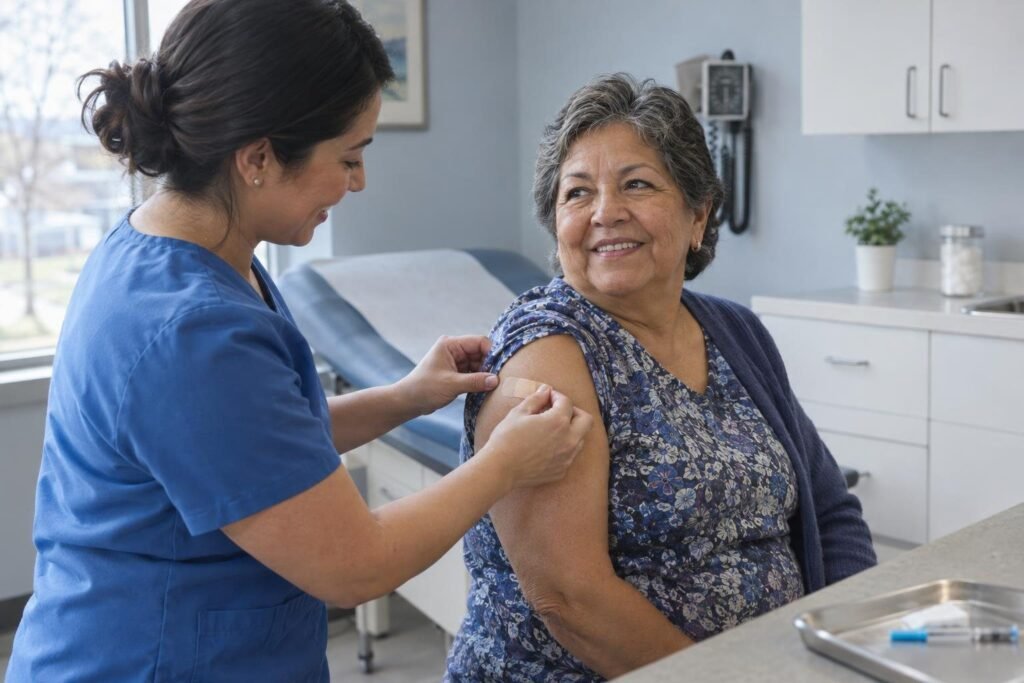
Adults 50 and older are advised to get a yearly flu shot, two shingles shots and a pneumococcal vaccine. All adults need a Td or Tdap booster every 10 years. The CDC also advises one RSV dose at 75 or older, or from age 50 if at higher risk. Maple Medical Center in Brookfield can review your record.
Why vaccines matter more as you get older
The body’s defenses weaken with age. Flu, pneumonia, shingles and RSV can hit harder and last longer. They can also lead to a hospital stay.
Vaccines lower your chance of getting very sick. Some are given every year. Others are given once or in two doses.
Dr. Ghani and Dr. Gill can look at your vaccine history and tell you what you are due for. Bring any vaccine cards or pharmacy records you have.

Recommended vaccines for adults, by age
| Vaccine | Who should get it | How often |
|---|---|---|
| Flu | All adults. At 65 and older, a higher-dose, adjuvanted or recombinant flu shot is preferred. | Every year, ideally in September or October |
| COVID-19 | Advice has changed in recent years | Ask us about the current recommendation for you |
| Shingles (Shingrix) | Adults 50 and older, and adults 19 and older with a weakened immune system | Two doses, 2 to 6 months apart |
| Pneumococcal (pneumonia) | All adults 50 and older, and younger adults with certain health conditions | Often one shot; some people need two, depending on past shots |
| RSV | All adults 75 and older, and adults 50 to 74 at increased risk | One dose only, not yearly |
| Tdap / Td | All adults | Tdap once if you never had it, then a Td or Tdap booster every 10 years |
A closer look at each vaccine
Flu
The CDC says September and October are good months for most people. Adults 65 and older should generally not get the flu shot in July or August, since protection can fade.
Shingles
Shingles can cause a painful rash and nerve pain that lingers. The CDC says to get Shingrix even if you have had shingles or the older shingles shot.
Pneumococcal
These shots protect against a common cause of pneumonia and blood infections. In 2024, the CDC lowered the age for all adults from 65 to 50.
RSV
RSV is a common virus that can be serious in older adults. The best time for the single dose is late summer or early fall.
Tdap and Td
These protect against tetanus, diphtheria and whooping cough. You may also need a booster after a deep or dirty wound.
COVID-19
Guidance has changed several times. Ask us about the current recommendation for your age and health.
Which vaccines do we have in the office?
Vaccine supply changes through the year. Please call (708) 485-4050 to ask which vaccines we have in the office before you come in. If you already have a visit booked, ask whether a vaccine can be given then.
Some vaccines are given at pharmacies instead. This is common for vaccines covered by Medicare Part D. We can tell you which ones you need, wherever you get them.
How Medicare covers vaccines
Medicare splits vaccines between two parts. Part B covers flu shots, pneumococcal shots and COVID-19 vaccines.
Part D, your drug plan, covers other recommended adult vaccines. These include the shingles, RSV and whooping cough (Tdap) vaccines.
One exception: Part B covers a tetanus shot when you need it to treat an injury.
A Medicare Advantage plan covers the Part B vaccines. If it includes drug coverage, it covers the Part D vaccines too. You may need to use certain pharmacies or providers. Check with your plan about where to go and what you’ll pay.
We accept many insurance plans, including Medicare, but not every plan. Call (708) 485-4050 and we’ll check yours before your visit. You can also read our insurance page.
If you have a long-term health condition
Health conditions can change which vaccines you need and when. Diabetes, heart disease, lung disease and a weakened immune system are common examples.
For instance, the CDC recommends RSV vaccine from age 50 for people at increased risk. Some younger adults with certain conditions need a pneumococcal vaccine before 50.
Bring a list of your health conditions and medicines to your visit. It helps your doctor choose the right vaccines, in the right order, for you.
Getting your vaccines up to date
Gather your records
Find any vaccine cards or pharmacy printouts you have. Your pharmacy can often print a list of shots it has given you.
Talk with your doctor
At your visit, your doctor reviews your age, health and past shots. You will learn which vaccines you are due for.
Call to ask what we have
Ask which vaccines we have in the office. For others, we can tell you where to get them, such as a pharmacy.
Plan any second doses
Shingles vaccine needs two doses. Write down when your second dose is due.
Tell us what you got
If you get a shot somewhere else, let us know so your chart stays complete.
Before a vaccine, tell us if you
These details help your doctor decide which vaccine to give and when.
- Have had a serious allergic reaction to a vaccine before
- Feel sick or have a fever on the day of your shot
- Have a weakened immune system, or take medicine that weakens it
- Have ever had Guillain-Barré syndrome
- Take a blood thinner or have a bleeding problem
- Are not sure which shots you have already had
After your vaccine
Most side effects are mild, such as a sore arm, tiredness or a low fever. The CDC says the shingles vaccine can make some people feel unwell for two to three days.
Some people feel lightheaded right after a shot. If you do, stay seated for a few minutes before you get up.
For a sore arm, a cool, wet cloth can help. Moving your arm gently through the day can ease stiffness.
Keep a record of the vaccine name and date. Call us if a side effect worries you or lasts more than a few days.
Questions we hear about immunizations
Do I need a flu shot every year?
Yes. Flu viruses change and protection fades, so the CDC recommends a flu shot every year. Adults 65 and older are advised to get a higher-dose, adjuvanted or recombinant flu shot.
I had chickenpox as a child. Do I need the shingles vaccine?
Yes. The chickenpox virus stays in your body and can wake up later as shingles. The CDC recommends two doses of Shingrix for adults 50 and older, even if you have had shingles before.
Is the RSV vaccine yearly like the flu shot?
No. Right now the RSV vaccine is a single dose. If you have already had it, the CDC says you do not need another one at this time.
Can I get more than one vaccine on the same day?
In many cases, yes. The CDC says many adult vaccines can be given at the same visit. Ask your doctor what makes sense for you.
Can I get my vaccines at Maple Medical Center?
Some vaccines may be available here, but supply changes. Call (708) 485-4050 to ask which ones we have. Some vaccines, especially those covered by Part D, are often easier to get at a pharmacy.
Does Medicare pay for the shingles vaccine?
The shingles vaccine is covered by Medicare Part D, your drug plan, not Part B. Call your plan to ask about costs and which pharmacies to use.
What about the COVID-19 vaccine?
COVID-19 vaccine advice has changed several times. Ask us about the current recommendation for your age and health at your next visit.
Related care
Preventive care & screenings
Preventive care helps find health problems early, often before you notice anything. Our doctors help adults and older adults know which screenings fit their age and history.
Learn more ›Care for older adults
Health care often gets more involved after 65. There are more medicines, more doctors and more questions. Our internal medicine doctors help older adults and their families keep it all in one place.
Learn more ›Physical exams
A yearly physical is a chance to check how you are doing and catch problems early. We also do pre-employment and work physicals for adults.
Learn more ›Primary care & internal medicine
Primary care is the doctor you see first for check-ups, new problems and long-term health. At Maple Medical Center, our internal medicine doctors care for adults and older adults.
Learn more ›Ready to see a doctor who knows you?
Call our Brookfield office and our team will find a time that works for you. We accept many insurance plans, including Medicare, but not every plan. We’ll check yours before your visit.
Important information
This page is general information, not medical advice. Vaccine recommendations change, so ask your doctor what is right for you. If you have trouble breathing, face or throat swelling, or feel faint after a vaccine, call 911.